Picking the best AI detector is harder than the marketing suggests, because every tool on this list claims 98 or 99 percent accuracy. Independent research has never confirmed that on the kind of text real people submit: edited drafts, paraphrased passages and essays by non-native writers. So we’ve set the vendor claims aside and compared the nine detectors people actually use on things you can check yourself: what they show you, what they cost, where they fail and what the published studies say. We’ve also started our own 120-text test. ZeroGPT went first, and its results are below; we’ll add the others as we get access. If you write with AI yourself, the best AI for writing covers the tools we’d use.
- Best when a verdict is disputed: GPTZero. It highlights sentence by sentence and has a “writing replay” that shows how a document was typed. If you have to defend or challenge a result, this is the one you want.
- Best free allowance: Pangram. You get 2,000 words a day with passage highlighting. GPTZero gives you 10,000 words a month and Scribbr 1,200 words per check.
- Best for publishers: Originality.ai. One scan covers AI detection, plagiarism, fact checking and readability, and you get shareable reports and team seats.
- Don’t rely on any of them alone. In a Stanford study, 89 of 91 essays by non-native English writers were flagged as AI by at least one of seven detectors. A high score is a reason to read more closely, not proof.
What the research says
Before you trust any score, it helps to know what has been measured outside the vendors’ own marketing.
Taken together, these results show that detectors do well on untouched output from the models they were trained on, and badly on edited text and formal, careful English. Unfortunately, that’s exactly the kind of text most disputes are about.
The nine detectors compared
| Detector | Shows which sentences | Free allowance | Cheapest paid plan | Built for |
|---|---|---|---|---|
 Pangrampangram.com | Yes, plus AI-assisted vs AI-generated split | 2,000 words a day | $20/month, 300,000 words | Editors, teachers |
 Originality.aioriginality.ai | Yes | 60 credits a month (3 scans a day) | $14.95/month, about 200,000 words | Publishers, agencies |
 GPTZerogptzero.me | Yes, plus writing replay | 10,000 words a month | Paid tiers, monthly or annual (45 % off) | Schools, teachers |
 Copyleakscopyleaks.com | Yes | Trial credits only | From $16/month, 25,000 words | Universities, enterprises |
 Winston AIgowinston.ai | Yes, PDF report | 2,000 credits, 14-day trial | $18/month or $60/year, 100,000 credits | Institutions needing reports |
 Saplingsapling.ai | Per-sentence scores | 2,000 characters per check | Pro, 100,000 characters per check | Developers, quick checks |
 Scribbrscribbr.com | Document score only | 1,200 words per check | Premium detector | Students, self-checks |
 QuillBotquillbot.com | AI / AI-refined / human split | Free | Included with Premium | Students, casual checks |
 ZeroGPTzerogpt.com | Highlighted sentences, PDF report | 15,000 characters per check | Premium plans | Casual checks |
We checked prices and limits on 28 September 2026 on each vendor’s own pricing page. If a vendor only shows prices after you log in, we say so in that tool’s section.
1. GPTZero, for when a verdict is disputed
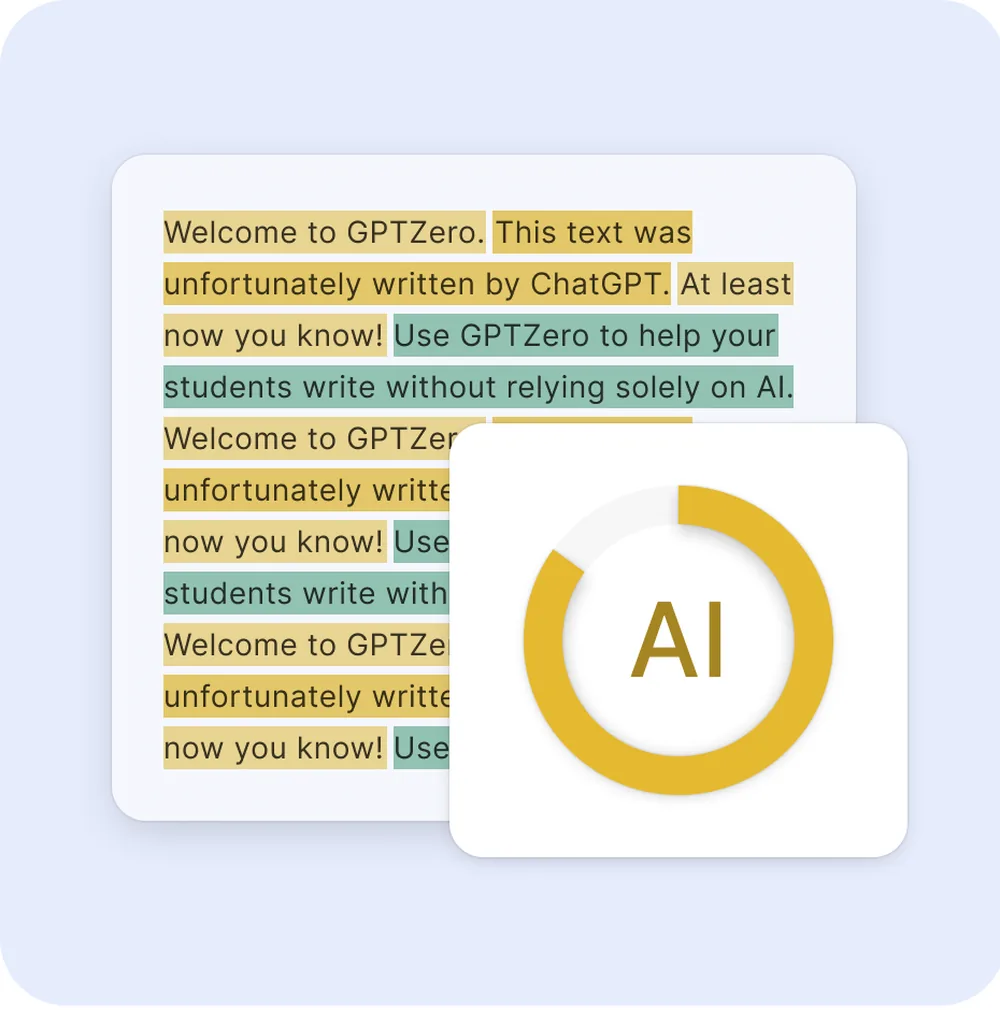
GPTZero is the detector most schools reach for, and it’s grown into a suite with AI detection, a plagiarism check, a hallucination checker and a “writing replay” that shows how a document was typed over time. The replay is the part we’d pay attention to. Every other feature on this list gives you a probability, whereas the replay gives you evidence. The sentence-level highlighting is also the clearest of the group, so if you disagree with a score you can go through it line by line.
+Where it wins
- Writing replay shows how the text was actually written
- Clearest sentence-by-sentence view
- Free tier is enough for occasional checks
−Where it loses
- Paid prices are hard to compare without logging in
- Same non-native bias as every perplexity-based tool
2. Pangram, the biggest free allowance
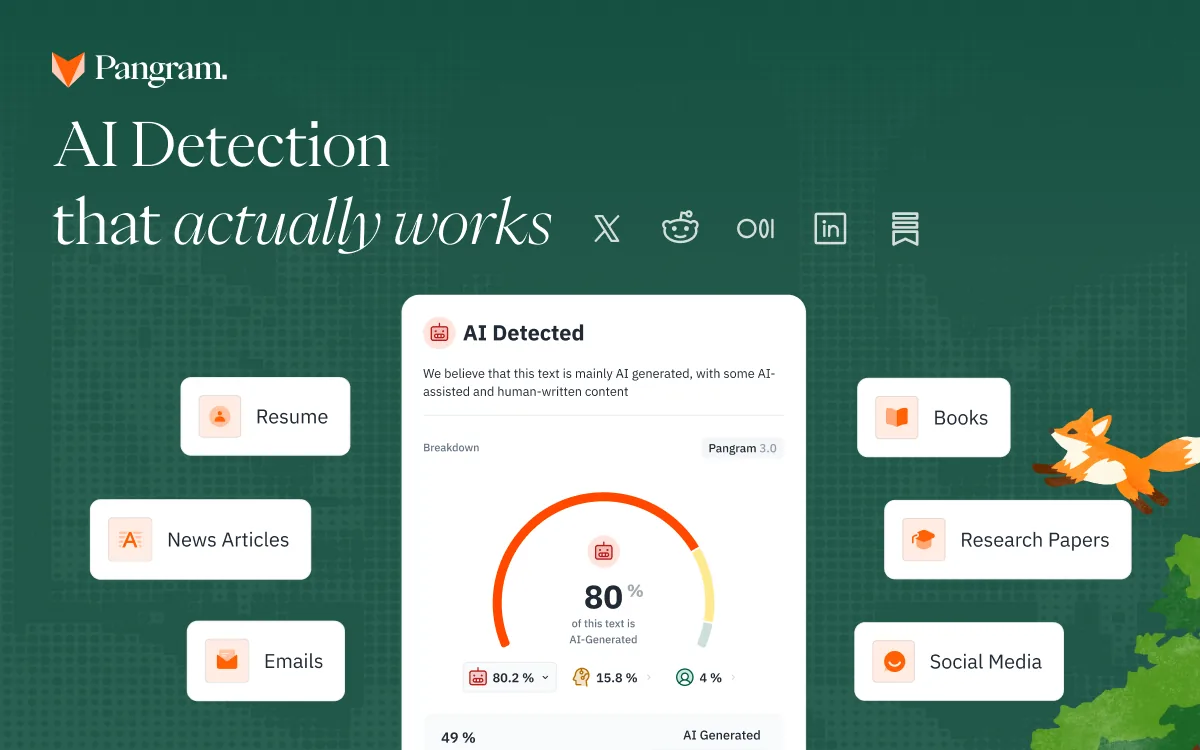
Pangram is the newest vendor here and has the most useful free tier. You get a verdict for the whole document, a split into AI-generated, AI-assisted and human portions, and highlighting on the passages it suspects. It covers more than 20 languages, which matters to us because most detectors are built for English first and get much worse on Norwegian.
+Where it wins
- Largest free daily allowance in this group
- Highlights the passages it suspects
- Multilingual, including Norwegian
−Where it loses
- Shortest track record of the nine
- No writing-history evidence like GPTZero’s replay
3. Originality.ai, for publishers and agencies
Originality.ai puts AI detection, plagiarism, a fact checker and readability scores in one scan and keeps a shareable report for each one. Agencies use it to check freelancers’ work, and the team features are built around that. Its pricing page still lists ChatGPT, GPT-4o, Gemini Pro, Claude 3.5 and Llama 3.1 as detected models and nothing newer, so check before you assume it handles current models.
+Where it wins
- Plagiarism, fact check and readability in one report
- Team seats, tags and scan history
- Cheapest paid plan of the “serious” tools
−Where it loses
- Free tier is tiny
- Pricing page lists 2024-era models
4. Copyleaks, for universities and companies
Copyleaks sells to universities and companies, which is why you’ll find LMS integrations, AI image detection and source-code detection next to the text detector. It gives a probability for each document and highlights the passages it suspects. There’s no ongoing free tier, just trial credits, and because one credit covers 250 words or one image, it’s awkward if you only check the odd text.
5. Winston AI, for PDF reports
Winston AI goes after the same buyers as Copyleaks, with a friendlier interface. It scans PDFs and images with OCR, detects AI-generated and deepfake images, and produces a PDF report you can attach to a case. It supports nine languages, including German, Spanish, Polish and Dutch. Norwegian isn’t one of them. Cloned voices are a separate problem, and Resemble AI, which we cover with other text-to-speech and voice cloning tools, now works mostly on deepfake detection.
6. Sapling, for developers and quick checks
Sapling’s own page says no current detector, its own included, should be used as a standalone check, and that false positives and negatives will happen. We wish every vendor said that. The detector combines token-level classification with per-sentence perplexity scoring and was recently retrained on ChatGPT, Claude, Gemini, DeepSeek and Qwen output. Sapling says false positives fell by 60 percent after that update.
7. Scribbr, for checking your own essay
Scribbr’s detector is meant for students who want to check their own work before handing it in. The free tool takes up to 1,200 words per check and gives one score for the whole document. The premium detector is the version Scribbr’s own comparison rates highest. It’s a sensible last check before you submit, but we wouldn’t use it to judge someone else’s work.
8. QuillBot, from the makers of a paraphraser
Most people know QuillBot for its paraphraser, which means the same company sells a tool that hides AI writing and one that finds it. The detector is free and gives you a percentage plus a split into AI-generated, AI-refined and human-written text. It’s handy, but treat what it says about paraphrased text with extra caution.
9. ZeroGPT and its 98.4 percent claim
ZeroGPT ranks well in search and claims 98.4 percent accuracy with under 1 percent false positives across “20+ LLM families”, a list that includes models which don’t exist yet. It’s free for up to 15,000 characters per check and produces a PDF report. Students are more likely to have used it than any other tool here, yet none of those claims come with a published method. On our own 120-text set it flagged none of the 40 human texts and missed 33 of the 40 written by Claude Fable 5.1.
How ZeroGPT did on our 120 texts
We put together 120 texts of 250 to 700 words and are running them through every detector we can reach by API. ZeroGPT went first, on 28 September 2026. We’ll add the others to this section as their accounts are set up.
| ZeroGPT (free tier) | Texts | Called AI (score above 50 %) | What it means |
|---|---|---|---|
| Human, native speakers | 20 | 0 | No false alarms; highest score 12 % |
| Human, English learners | 20 | 0 | No false alarms; highest score 14 % |
| AI, unedited (Claude Fable 5.1) | 40 | 7 | Missed 33 of 40; median score 10 % |
| AI, rewritten by a second AI pass | 14 | 1 | Missed 13 of 14 |
| AI, paraphrased | 14 | 2 | Missed 12 of 14 |
| Human, polished by AI | 12 | 1 | One writer would have been wrongly flagged |
Bear two limitations in mind. The AI texts all come from one model, Claude Fable 5.1, so a detector trained mainly on ChatGPT output may do better or worse on other models, and texts from those models would change the picture. Second, we used ZeroGPT’s free tier through its public endpoint, the same way the website uses it, so these are the numbers a student or teacher would see. For the assistants behind those other models, see our guide to ChatGPT alternatives.
Why detectors flag human writing
Most detectors measure how predictable a text is. Language models pick likely words, so what they write is smooth and has few surprises. The trouble is that plenty of good human writing is predictable too. Think of formal essays, technical documentation, anything written to a template and, most of all, writing by people who learned English as a second language and stick to the safest phrasing. The Stanford study that first measured this in 2023 found that all seven detectors it tested agreed 18 of 91 TOEFL essays were AI-written, and only two of the 91 got past every detector. Vendors have retrained since then, but the way detection works hasn’t changed.
What to do if a detector flags your work
- Ask which tool and which score. A single score above 50 percent from one tool is weak evidence. Two tools agreeing on the same passages is stronger.
- Show your drafts. Version history in Google Docs or Word, your notes and your sources are much better proof than a counter-scan.
- Run a second detector yourself and keep the report. If the tools disagree, that’s your argument.
- If you write in English as a second language, say so. Most institutions know about the bias by now, even if their software doesn’t.
Which detector for which job
- You check now and then, for free: Pangram first, then GPTZero. Both highlight passages rather than giving you one number.
- You grade or edit every week: GPTZero for the writing replay, or Pangram Individual if you also want plagiarism checked on every scan.
- You need reports for a formal process: Winston AI or Copyleaks. Both scan uploaded documents and give you a PDF to attach.
- You publish content and need plagiarism checks too: Originality.ai and Pangram Individual both cover AI and plagiarism in one scan.
- You write in Norwegian or another language that isn’t English: Pangram is the only one of the nine that lists broad multilingual support. Try it on your own texts first.
Frequently asked questions
Can an AI detector be 99 percent accurate?
Not on the kind of text real people submit. Vendors reach those figures on their own benchmarks, but no independent study has confirmed them for text with edits, paraphrasing or non-native English. The RAID benchmark found detectors “easily fooled” by adversarial edits, OpenAI withdrew its own classifier after it caught only 26 percent of AI text, and in our own test ZeroGPT caught 7 of 40 texts written by a current model.
Do detectors work on Claude and Gemini, or only ChatGPT?
The better ones now train on several model families, but coverage varies. Sapling names ChatGPT, Claude, Gemini, DeepSeek and Qwen, and Pangram claims broad coverage. Several vendors still list only 2024-era models on their pricing pages, and every study shows accuracy dropping on models a detector hasn’t seen.
Can you beat a detector with a paraphraser or a “humanizer”?
Often, yes. The RAID benchmark’s main finding was that paraphrasing, unusual sampling settings and repetition penalties all reduce detection. Tools that highlight suspicious sentences give you more to go on than ones that return a single number for the whole document.
Which detector do universities use?
Mostly Turnitin. Its AI indicator is built into the plagiarism system many universities already license, so it’s the one students meet most often. Members of the public can’t use it, which is why it isn’t in this comparison. GPTZero and Copyleaks are the most common alternatives sold directly to schools.
Is it safe to paste confidential text into a detector?
Only if you’re happy for it to be stored, because you should assume it will be. Most vendors keep scans in your account history and some use submissions to improve their models. For anything confidential, read the vendor’s data policy first or use a tool with an explicit no-retention option.
Sources and method
We checked prices, limits and feature claims on 28 September 2026 on the vendors’ own pages. Research findings are quoted from the papers below. Our own test uses 120 texts: 40 human texts published in 2018–2019 on Stack Exchange hobby sites and the English Language Learners site (CC BY-SA), 40 texts written by Claude Fable 5.1 from 40 prompts, and 40 mixed texts (rewritten, paraphrased, or human texts polished by AI). ZeroGPT was tested on 28 September 2026 through its public endpoint, and we’ll add further detectors as API access is arranged. The text set and scoring sheet are available on request.
- Liang, W. et al., GPT detectors are biased against non-native English writers, 2023
- Dugan, L. et al., RAID: A Shared Benchmark for Robust Evaluation of Machine-Generated Text Detectors, ACL 2024
- OpenAI, New AI classifier for indicating AI-written text, 2023, with the July 2023 withdrawal note
- Turnitin, Understanding the false positive rate of our AI writing detection, 2023
- Pangram Labs, pricing
- Originality.ai, pricing
- GPTZero, pricing
- Copyleaks, pricing
- Winston AI, pricing
- Sapling, AI content detector
- Scribbr, AI detector
- QuillBot, AI content detector
- ZeroGPT