Updated 30 September 2026: OpenAI launched GPT-6.1 Sol on 29 September, in ChatGPT Work, Codex and the API at the same price as GPT-6 Sol, and added a $500 Pro 500 plan and its dots agents. We have added them to the models, plans, API and apps sections; our verdict is unchanged.
DeepSeek is the strongest free rival ChatGPT has had. A Chinese lab gives away its model weights, charges a fraction of OpenAI’s prices and puts its current models in a free app, while ChatGPT keeps its newest models behind a paid plan. There is one big catch, which we come to below. This guide sets DeepSeek-V4.1-Flash and V4-Pro against OpenAI’s GPT-6 family as they stand on 28 September 2026. We checked prices, model names and policies on the vendors’ own pages today; we haven’t run our own tests.
- Both are free to chat with. DeepSeek’s app and website cost nothing and run its current models. ChatGPT Free gives you unlimited text chats with GPT-5.6 Luna, and GPT-6 only arrives on Plus at €23 a month.
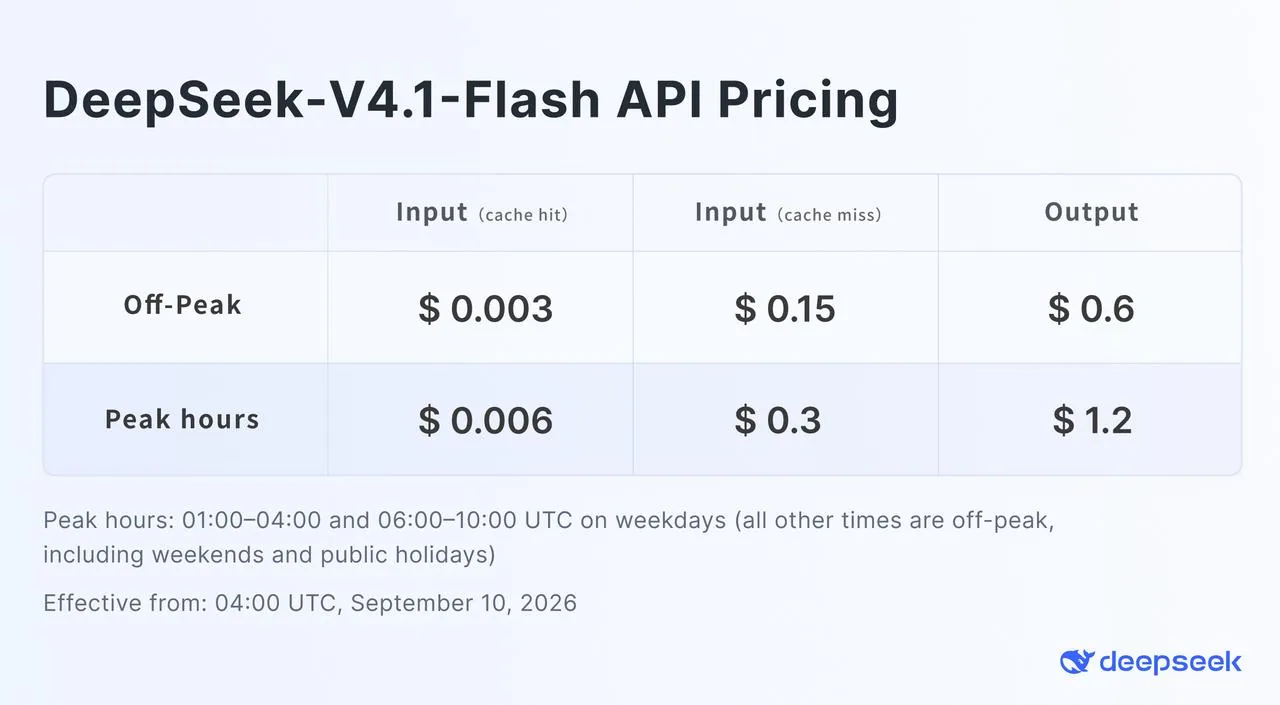
- On the API the price war has swung back. DeepSeek-V4.1-Flash costs $0.30 in and $1.20 out per million tokens at peak, half that off-peak. GPT-6 Luna is $0.10 and $0.50, which makes it cheaper than DeepSeek at list price for the first time.
- The catch is where your data lives. DeepSeek stores personal data in China under Chinese law. Italy’s regulator blocked it in 2025, and Berlin’s data protection commissioner reported the app to Apple and Google. OpenAI’s EU controller is in Dublin and its servers are mostly in the US.
- DeepSeek’s real edge is open weights. V4.1-Flash and V4-Pro are MIT-licensed and downloadable, so you can run them on your own hardware. OpenAI’s only open models are the gpt-oss pair from August 2025.
The models, as of September 2026
DeepSeek’s current model is DeepSeek-V4.1-Flash, released on 10 September 2026 and served on the API as deepseek-flash. It is a 552-billion-parameter mixture-of-experts model, but it only activates 8 billion parameters to read your input and 16 billion to write the answer, and it comes with 1 million tokens of context and native image understanding. Above it sits DeepSeek-V4-Pro, at 1.6 trillion parameters, generally available since 13 August. On 10 September DeepSeek said it was “phasing out V4-Pro” because the smaller model beat it on performance, cost and speed. It then noted in its change log that it would keep serving V4-Pro “in response to user demand”. A V4.1-Pro has been promised, but without a date.
OpenAI’s line-up is the GPT-6 family. GPT-6 Astra, launched on 3 September 2026, is the flagship at $10 in and $50 out per million tokens. GPT-6 Sol and GPT-6 Luna followed on 22 September at $2 / $10 and $0.10 / $0.50, a 50 percent cut on their GPT-5.6 predecessors. All three take 1.05 million tokens of context and return up to 128,000. On 29 September OpenAI added GPT-6.1 Sol, an upgrade to GPT-6 Sol at the same $2 and $10 list price, which it says nearly matches Astra on agentic coding, computer use and professional work. It is in ChatGPT Work and Codex for Plus, Pro, Business, Enterprise and Edu users, but not yet in Chat, and OpenAI doesn’t list it for Free or Go. ChatGPT’s free tier still runs the previous generation’s small model, GPT-5.6 Luna.
| Model | API price per 1M tokens (in / out) | Context / max output | Weights | Where you use it |
|---|---|---|---|---|
 DeepSeek-V4.1-Flashdeepseek-flash · 10 Sep 2026 | $0.30 / $1.20 peak $0.15 / $0.60 off-peak | 1M / 384K | Open, MIT | App, web, API, self-host |
| DeepSeek-V4-Prodeepseek-v4-pro · GA 13 Aug 2026 | $1.32 / $3.96 peak $0.66 / $1.98 off-peak | 1M / 384K | Open, MIT | App “Expert Mode”, API, self-host |
 GPT-6 Astragpt-6-astra · 3 Sep 2026 | $10 / $50 | 1.05M / 128K | Closed | ChatGPT Plus and up, API, Azure, Bedrock |
| GPT-6 Solgpt-6-sol · 22 Sep 2026 | $2 / $10 | 1.05M / 128K | Closed | ChatGPT Plus and up, API |
| GPT-6.1 Solgpt-6.1-sol · 29 Sep 2026 | $2 / $10 | Not stated at launch | Closed | ChatGPT Work and Codex (Plus and up), API; not yet in Chat |
| GPT-6 Lunagpt-6-luna · 22 Sep 2026 | $0.10 / $0.50 | 1.05M / 128K | Closed | ChatGPT Plus and up; Free and Go in the desktop app; API |
What the free tiers include
ChatGPT’s Free plan, as shown to a visitor in the EU on 28 September, gives “unlimited text chats with GPT-5.6 Luna”, subject to abuse guardrails, plus limited uploads, images, voice, deep research and memory, all in a 27,000-token context window. Go costs €8 a month, gets you more of everything and may show ads. Plus, at €23, is where the GPT-6 models arrive, with a 256,000-token reasoning window. Pro starts at €103 and adds Astra-powered “Pro reasoning” and five times the usage. Since 29 September Pro comes in three monthly tiers: Pro 100 ($100), Pro 200 ($200, open to new subscribers again) and a new Pro 500 ($500) with 25 times the Plus allowance and Ultrafast, OpenAI’s premium speed tier. OpenAI gave those prices in US dollars only.
DeepSeek has no plan page because there are no plans. Its app announcement calls the app “100% FREE – No ads, no in-app purchases”, and the website today lists a web version, mobile apps and the API, with no consumer subscription anywhere. The chat product runs V4.1-Flash, with V4-Pro available as an “Expert Mode”, plus web search, deep think and file upload. In one sense, though, you get what you pay for: there is no service guarantee and no published usage limit.
API prices
For most of 2025 DeepSeek was an order of magnitude cheaper than anything from OpenAI. That isn’t quite true any more. GPT-6 Luna at $0.10 in and $0.50 out comes in below DeepSeek-V4.1-Flash’s peak rate of $0.30 and $1.20, and still below its off-peak rate of $0.15 and $0.60. Peak, in DeepSeek’s billing, means 01:00 to 04:00 and 06:00 to 10:00 UTC on weekdays; everything else, weekends included, is half price. Where DeepSeek fights back is caching. A cache hit on V4.1-Flash costs $0.006 per million tokens at peak and $0.003 off-peak, against OpenAI’s $0.01 on Luna, and the V4.1 architecture cuts the cache’s memory footprint to a quarter of the previous generation’s.
Move up a tier and DeepSeek is cheaper again. V4-Pro costs $1.32 in and $3.96 out at peak, or $0.66 and $1.98 off-peak, against $2 and $10 for GPT-6 Sol and the new GPT-6.1 Sol, and $10 and $50 for Astra. We ran the numbers for a support bot handling 10,000 conversations a month at roughly 3,000 input and 700 output tokens each, which comes to 30 million input and 7 million output tokens. On GPT-6 Luna that comes to about $6.50 a month. On V4.1-Flash it is $17.40 at peak or $8.70 off-peak, on GPT-6 Sol or GPT-6.1 Sol $130, on V4-Pro off-peak about $34, and on Astra $650. At the small tier, then, you’d pick on quality and data handling rather than price. Higher up, DeepSeek’s price still does the deciding. We set Grok 4.7’s API prices against OpenAI’s in Grok vs ChatGPT.
Coding and maths, by the vendors’ numbers
Both companies publish benchmark tables, and both pick the comparisons that flatter them, so treat everything here as a claim rather than a finding. DeepSeek’s V4.1-Flash launch table puts the model at 74.2 percent on DeepSWE v1.1, a software-engineering benchmark, against 73.0 for GPT-5.6 Sol and 74.0 for Claude Opus 5, and gives it a Codeforces rating of 3471 with no OpenAI figure alongside. On the newer Terminal-Bench 4.0 it is more modest, at 31.2 percent against 39.9 for GPT-5.6 Sol. On MathArena Apex, a competition-maths test, it reports 65.6 percent, and on GPQA Diamond 90.9.
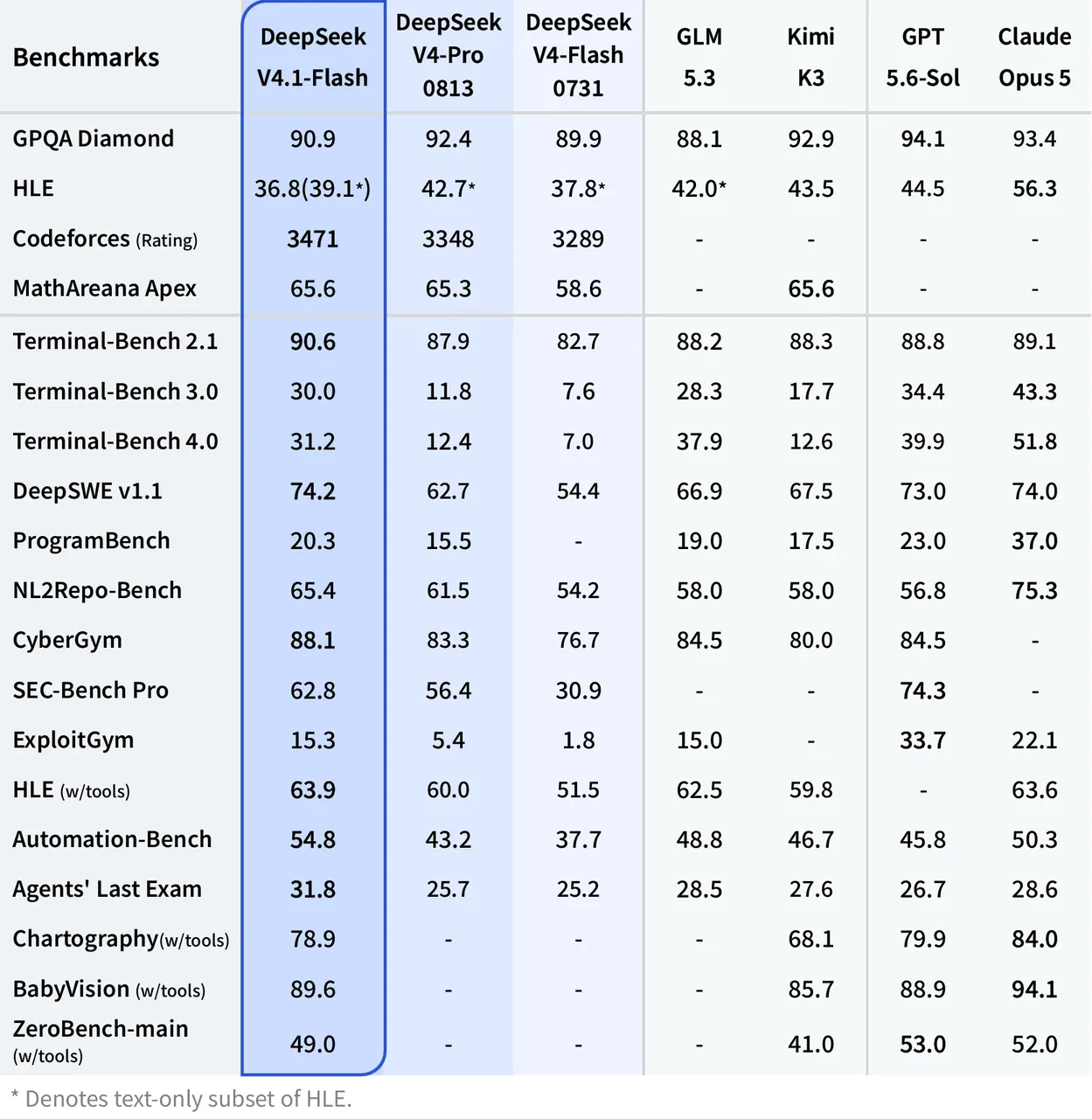
OpenAI’s GPT-6 Astra page compares against a different set of models. Astra reports 57.9 percent on Terminal-Bench 4.0, 74.1 on DeepSWE v1.1, 96.0 on GPQA Diamond and 97.6 on FrontierMath Tier 4, a research-level maths benchmark OpenAI says it has “saturated”. DeepSeek doesn’t appear in OpenAI’s tables and GPT-6 doesn’t appear in DeepSeek’s, so there is no vendor-published number that puts the two current flagships side by side. The most we can say is that DeepSeek’s small, cheap model reports coding scores in the same band as OpenAI’s previous mid-tier model, while OpenAI’s new flagship is well ahead on the hardest agentic and maths tests, by its own account. OpenAI’s GPT-6.1 Sol post of 29 September also claims the new mid-tier model matches Astra on DeepSWE v1.1 at roughly a fifth of the cost. DeepSeek has also open-sourced a coding agent of its own, a research prototype that works from GitHub and replies with pull requests.
Privacy and where your prompts go
If you handle other people’s data, this section settles it. DeepSeek’s privacy policy, updated 10 February 2026, names Hangzhou DeepSeek Artificial Intelligence Co., Ltd. as controller and states that “we directly collect, process and store your Personal Data in People’s Republic of China”. That covers prompts, uploaded files, chat history, device identifiers and your IP address. The terms of use, updated 27 March 2026, are governed by the laws of mainland China. DeepSeek may also use inputs and outputs to improve the service after de-identification; the opt-out is labelled “Improve the model for everyone”.
OpenAI’s policy for users outside the United States, updated 6 February 2026, names OpenAI Ireland Limited in Dublin as controller for the EEA and says data is processed “in our facilities and servers in the United States” under “legally valid transfer mechanisms”. Your content can be used for training unless you turn off the same “Improve the model for everyone” setting. Temporary chats are deleted within 30 days, and Business and Enterprise workspaces are excluded from training by default. So neither company keeps consumer data in the EU. What differs is which legal system can compel access to it.
Open weights
None of that applies if you download the model. DeepSeek publishes the weights of V4.1-Flash and V4-Pro on Hugging Face under the MIT licence, which allows commercial use, modification and redistribution with almost no strings attached, and it ships inference code for Transformers, vLLM and SGLang. Run the model on your own servers and no prompt ever reaches Hangzhou. OpenAI has nothing comparable for its current models.
Be realistic about the hardware, though. V4.1-Flash has 552 billion parameters in total and V4-Pro 1.6 trillion, and DeepSeek’s launch post talks about deployments of “2,000 GPUs + a storage cluster”. These are datacentre models. OpenAI’s open-weight offer is smaller and older: gpt-oss-120b and gpt-oss-20b came out in August 2025 under Apache 2.0, the larger one sized for a single 80 GB GPU. They aren’t served in ChatGPT or the API, and nothing newer with open weights has followed.
Apps and everyday use
Both are on the web, iOS and Android. ChatGPT also has desktop apps, ChatGPT Work, Codex, image generation, voice with video, memory and enterprise controls, and the paid plans are mostly about how much of that you get. DeepSeek’s app is leaner: you get chat, search, deep think, file upload and image input, synced across devices, and that’s about it. If you want an assistant that also draws, talks and fills in forms on your computer, ChatGPT is the more complete product. If you want a capable free chatbot and nothing more, DeepSeek is hard to argue with. On 29 September OpenAI also announced dots, always-on agents running on GPT-6 Astra with their own cloud computer, but Pro access excludes the European Economic Area, Switzerland and the UK at launch.
+Reasons to pick DeepSeek
- Free app and web access to its current models
- Open weights under MIT: self-host, keep data in-house
- Cheaper at the mid tier and on cache hits
- 1M context, 384K output on every model
+Reasons to pick ChatGPT
- Irish controller, US servers, no Chinese jurisdiction
- GPT-6 Astra leads the hardest coding and maths evals, per OpenAI
- Images, voice, Codex, desktop agents, enterprise controls
- GPT-6 Luna is now the cheaper small model at list price
Verdict
If you’re a private individual who wants a free, capable chatbot and you accept that the data goes to China, DeepSeek gives you more model for nothing than ChatGPT Free does, since ChatGPT keeps its current generation behind the €23 Plus plan. If you handle client or employee data in the EU, the hosted DeepSeek service is a liability, and ChatGPT or the OpenAI API is the choice you can defend. Want something else entirely? Our ChatGPT alternatives guide covers Claude, Gemini, Perplexity and six more.
For developers, the picture changed this month. GPT-6 Luna at $0.10 and $0.50 takes away DeepSeek’s price advantage at the small tier, so choose on quality there. DeepSeek still wins at the mid tier, and wins outright if you can self-host. MIT-licensed weights are the one thing OpenAI doesn’t sell at any price.
Frequently asked questions
Is DeepSeek really free?
Yes. The DeepSeek app and website run its current models with no subscription, no ads and no in-app purchases, according to DeepSeek’s own app page. Only the API costs money: $0.30 in and $1.20 out per million tokens for V4.1-Flash at peak, half that off-peak.
Is DeepSeek cheaper than ChatGPT on the API?
Not at the small tier any more. GPT-6 Luna is $0.10 and $0.50 per million tokens, below V4.1-Flash’s $0.30 and $1.20 at peak. One tier up it still is: DeepSeek-V4-Pro at $1.32 and $3.96 is well below GPT-6 Sol and the new GPT-6.1 Sol, both at $2 and $10.
Where does DeepSeek store my data?
In the People’s Republic of China. DeepSeek’s privacy policy, updated 10 February 2026, says it collects, processes and stores personal data there, including prompts, uploaded files and chat history, and its terms are governed by mainland Chinese law.
Is DeepSeek banned in Europe?
No, not EU-wide. Italy’s data protection authority limited processing of Italian users’ data on 30 January 2025, and Berlin’s commissioner reported the apps to Apple and Google on 27 June 2025. Elsewhere in the EU the app and API are available, and the open weights can be run anywhere.
Which is better at coding?
On the hardest agentic tasks, GPT-6 Astra, going by the vendors’ own tables. DeepSeek-V4.1-Flash scores 74.2 on DeepSWE v1.1 and Astra 74.1, in separate runs by separate companies, but on Terminal-Bench 4.0 OpenAI reports 57.9 for Astra against DeepSeek’s 31.2. For what it costs, DeepSeek is still very good.
Sources and method
We took model names, prices, context windows and licences from DeepSeek’s and OpenAI’s own documentation on 28 September 2026, and rechecked OpenAI’s pages on 30 September 2026 after its 29 September announcements. ChatGPT plan prices are those displayed in euros to a visitor in the EU on that date. Benchmark figures are quoted from each vendor’s launch material and are their claims, not our measurements; we haven’t run a head-to-head test. Regulatory actions are quoted from the authorities’ own press releases. The worked cost example uses list prices only.
- DeepSeek, Models & Pricing: model names, context, max output, peak and off-peak prices
- DeepSeek, DeepSeek-V4.1-Flash release (10 Sep 2026): architecture, benchmark table, pricing figure, V4-Pro phase-out notice
- DeepSeek, Change Log: V4-Pro GA date, decision to keep serving V4-Pro after 14 September
- DeepSeek on Hugging Face, DeepSeek-V4.1-Flash and DeepSeek-V4-Pro: MIT licence, parameter counts, inference frameworks
- DeepSeek, Privacy Policy and Terms of Use: data location, controller, governing law, training opt-out
- DeepSeek, Introducing DeepSeek App: App Store and Google Play availability, free with no ads
- OpenAI, ChatGPT pricing: plan prices, models per plan, context windows
- OpenAI, API pricing and Models: GPT-6 prices, context, max output
- OpenAI, GPT-6 Astra and Introducing GPT-6 Sol and Luna: release dates, benchmark tables, availability
- OpenAI, Privacy policy (outside the US): controller, server location, retention, data controls
- Axios, OpenAI releases GPT-6 Astra (3 Sep 2026): launch date; OpenAI’s own page carries no date
- OpenAI on Hugging Face, gpt-oss-120b: Apache 2.0 licence, parameters, release
- Garante per la protezione dei dati personali, The Italian DPA blocks DeepSeek (30 Jan 2025)
- Berliner Beauftragte für Datenschutz und Informationsfreiheit, press release (27 Jun 2025)
- OpenAI, Introducing GPT-6.1 Sol (29 Sep 2026): availability, API price, DeepSWE v1.1 claim
- OpenAI Help Center, About ChatGPT Pro tiers: Pro 100, Pro 200 and Pro 500 prices, Ultrafast
- OpenAI, DevDay 2026 Recap (29 Sep 2026): Pro 500 allowance
- OpenAI, Introducing dots: model, rollout, EEA, Switzerland and UK exclusion